
Robertson Parole and Probation
Parole and probation both allow a person to live outside a prison, but they arise in different ways. The Tennessee Board of Parole makes parole decisions for eligible state sentences. Tennessee Department of Correction field services then administer community supervision. Probation usually comes from a court judgment and may begin without a state-prison term. A Robertson County bond release is neither one. It is a pretrial release while the charge remains pending.
A county release marked time served also does not prove supervision. The judgment may impose probation, while a second case, hold, or registration duty may remain. Read the Robertson County court disposition and TDOC record before naming the status. The official labels matter.
| Record type | How it begins | Best public check |
|---|---|---|
| Parole | Conditional release tied to an eligible state sentence and Board action | TDOC FOIL status, hearing fields, and assigned location |
| Probation | Court-ordered supervision or a qualifying determinate release | Court judgment plus FOIL supervision status |
| Bond | Pretrial departure from jail | Jail release detail and court docket |
| Discharge | Active supervision or sentence has ended | Current FOIL status and source records |
- Parole
- Conditional community release under an active state sentence.
- Probation
- Court-ordered community supervision, sometimes instead of confinement.
- Absconder
- A person alleged to have stopped reporting or left supervision without permission.
- Discharge
- The formal end of custody or supervision shown by the responsible agency.
Check Robertson County Supervision
The first public state source is the TDOC Felony Offender Information Lookup, known as FOIL. It covers people currently or formerly in TDOC custody or supervision. It is not a county misdemeanor jail archive. Use the name and TOMIS or TDOC number when known, then match more than the name before relying on a result.
- Search FOIL by full name and state offender identifier when available.
- Open the correct record and read Supervision Status, Assigned Location, active sentences, Sentence End Date, and Release Eligibility Date together.
- If FOIL says Parole or Probation, use Assigned Location to identify the office that actually owns the case.
- Check the court judgment for the sentence, probation term, conditions, revocation, or later order.
- For parole, compare the Parole Hearing Date and Parole Hearing Result with the present custody status. A grant alone is not proof of physical release.
A future Sentence End Date does not mean prison confinement continues until that date. A parolee may live in the community while the sentence remains active. Release Eligibility Date is only the statutory threshold for release consideration where it applies. Neither field is a guaranteed walking-out date. The broader Robertson County released inmate search explains how the jail, court, and state records fit together.
Robertson Supervision Office Records
Robertson County is in TDOC District 81. The official community supervision field-office directory lists a Springfield probation and parole office. It is a useful local fallback after FOIL shows an active status. Assigned Location must still be checked first. A transfer, interstate compact, or specialized caseload can place responsibility elsewhere.
1310 Memorial Boulevard
Springfield, TN 37172
615-382-2413
Fax: 615-382-3150
Hours: confirm with the office
The District 81 office is at 1441 Tulip Poplar Drive, Gallatin, TN 37066, and its number is 615-451-5808. Office staff can route a status question when the public record points to their district. They should not be asked to disclose protected reporting details. A person’s officer and written order control actual instructions.
The state says probationers should report within 48 hours after placement on probation or release from split confinement. That broad rule does not replace an individual order. Parole follows the approved release plan and Board or TDOC conditions.
The official District 81 directory shows the Robertson office and its contact route.
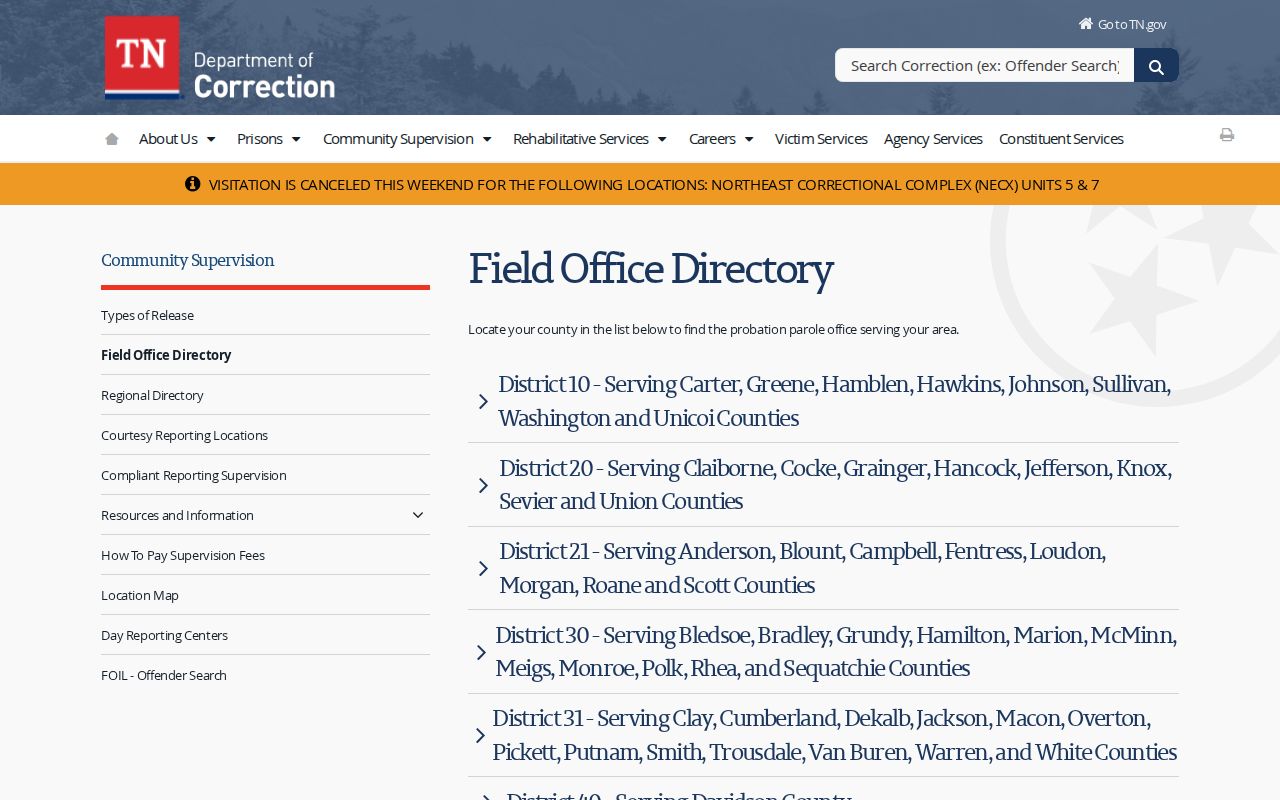
The directory is the right source for the office address, while FOIL remains the person-specific source for Assigned Location.
Robertson Parole Hearing Records
The Tennessee Board of Parole conducts parole hearings and makes release decisions. Hearing officers may issue recommendations, but Board members may adopt, change, or reject them. Outcomes include a grant, denial, deferment, revocation, reinstatement, or rescission. Copy the exact result. A favorable result can still be followed by plan review, a detainer, sentence verification, or another pre-release condition.
Current prison and county-jail schedules are updated weekly, usually Monday, or Tuesday after a Monday holiday. The Board schedule page directs requests to BD.HearingSchedules@tn.gov and advises confirming late changes through the Parole Hearings Division at 615-741-1150. FOIL is the public person-level route for Parole Hearing Date and Parole Hearing Result. It is not an actual release-time log.
The Board of Parole site identifies the decision-making agency and its public services.

The Board source explains the decision layer, while later FOIL status shows whether physical custody or community supervision changed.
Note: A parole grant and a Robertson County jail release entry document different events and should never be merged into one date.
Robertson Release Warrant Check
A released booking does not establish that every warrant, bond condition, or court restraint has ended. This is especially important in Robertson County. The Sheriff’s Warrant Division states that it receives more than 12,000 civil and criminal warrants each year and also manages bond conditions and orders of protection. That volume is context about the local warrant system, not evidence about any named person.
A “VOP” entry may mean an alleged violation of probation. It is not a final finding. Likewise, a Most Wanted notice is a sheriff publication as of its displayed date, not a TDOC absconder list and not proof of guilt. Verify the underlying warrant or court event through the sheriff and clerk. Then compare it with FOIL and the supervision office.
When a person is described as an absconder, the term means the agency alleges the person stopped reporting or left supervision without permission. It does not mean the original jail release was reversed. A later arrest, revocation hearing, and custody entry each create separate records. Preserve those distinctions when tracing the sequence.
Robertson Supervision Conditions
Conditions vary by judgment, release certificate, parole plan, and later order. Common themes may include reporting, travel limits, program participation, payment duties, or compliance with court restrictions, but the public website should not invent terms for an individual. The signed court or Board documents and the supervising officer are the controlling sources.
An alleged violation can lead to a warrant and a hearing. It does not automatically prove revocation. Board proceedings distinguish preliminary and final revocation, along with other hearing types. A court handles probation revocation under its own case. The docket can show the filing, hearing, and order, while FOIL can show the current supervision or custody status after state data is updated.
TN SAVIN and VINE serve custody-change notification. They do not publish a full list of supervision conditions. If a parolee returns to state custody, TDOC VINE may report a location or transfer change. For a Robertson County jail event, the county feed may report the new booking or release. The two feeds should be checked at the correct custody layer.
Robertson Supervision Discharge
Supervision ends through a formal agency or court event, not because a name disappears from a recent jail list. For a state case, FOIL can remain useful after prison release because it covers current and former TDOC custody or supervision. “Inactive” is the clearest public indicator that TDOC no longer shows active custody or supervision, subject to the agency disclaimer and later corrections.
Sentence expiration, discharge from supervision, and case dismissal describe different legal events. Sentence expiration concerns the sentence calculation. Discharge concerns active control by the supervising agency. Dismissal concerns the court’s result on a charge. An expunction can later change public access to records but does not rewrite the physical release date. For a durable answer, retain the FOIL status as checked, the judgment or discharge order, and any source release record.
When the public fields conflict, ask the office that owns the record. TDOC resolves state custody and supervision data. The Board explains parole decisions. The Robertson County clerk supplies court orders. The sheriff supplies the county jail movement or release record. This source-by-source method avoids treating one database as proof of every stage.
Robertson Probation Court Records
The Robertson County court judgment is the primary source for a probation sentence. It can show the term, jail credit, conditions, later violation filings, revocation, and discharge orders. A jail release detail cannot supply that full history. For a Circuit or Criminal Court matter, the Tennessee court directory lists the Robertson County clerk at 501 South Main Street, Room 109, Springfield, with telephone 615-384-7864. General Sessions or another court may hold the record when the case did not proceed there.
Ask for the docket, judgment, disposition, and any order that changed custody or probation. The court order proves what the judge directed. It may not show the minute correctional staff completed a release, so pair it with the jail movement record or FOIL status as needed. Historic county archive indexes can help locate older cases, but the archives warn that working indexes may be incomplete and change as records are added.
Public Record Search
Sponsored Results