
Robertson Release Date Meanings
A projected date is a calculation made before a person leaves custody. An actual release date records a completed departure. Tennessee Department of Correction records use more precise labels. Sentence End Date is the closest public field to expected sentence expiration, while Release Eligibility Date marks a legal threshold at which parole or another release process may become possible. Eligibility does not mean release was granted. Even a favorable Board of Parole result is not proof that prison staff released the person.
County jail dates work differently. A Robertson County Detention Facility detail reports admit and release times after processing. A court judgment may state a term, jail credit, time served, or bond condition, yet the jail movement record is the best source for the physical exit time. Someone transferred to TDOC, USMS, another jail, or ICE has been released from the county booking but has not necessarily entered the community.
Find a Robertson Release Date
Begin with the last known custodian. The official TDOC FOIL information page leads to the state search for people currently or formerly in TDOC custody or supervision. Robertson County’s jail database is the better source for a county-only sentence. A federal sentence belongs in BOP records, while a federal pretrial order belongs in the federal court and USMS path.
- Identify the custody system. Check whether the person remained in the county jail, entered TDOC, or moved to a federal or immigration custodian.
- Use FOIL for state custody. Search by name and TOMIS or TDOC number when known, then match more than the name.
- Read the exact fields. Compare status, assigned location, Sentence End Date, Release Eligibility Date, hearing fields, and active Tennessee sentences.
- Use jail and court records locally. Ask the sheriff for the release or movement entry and the clerk for the judgment, jail credit, and later orders.
- Confirm the event. A date is not final until the responsible agency posts release, discharge, transfer, or a new custody status.
The Robertson County released-inmate search and records path explains the county released mode for a completed local departure. FOIL should not be used as a substitute for a misdemeanor jail archive. A person who served only a county term may never have a state offender record.
FOIL’s official interface and disclaimer show why its labels must be read as published. The state FOIL explanation is pictured below.
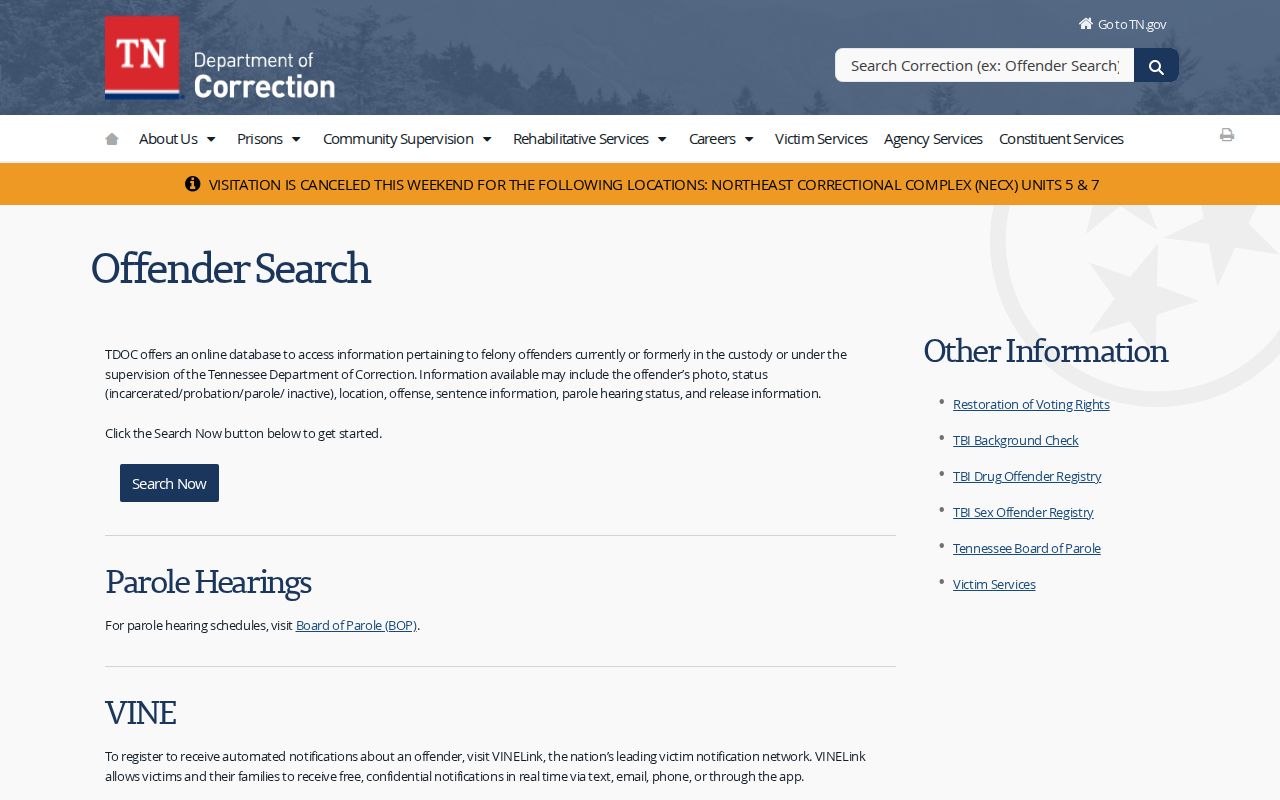
The state screen supports a date inquiry, but TDOC warns that court papers and later corrections can change the record.
Robertson State Release Status
No single FOIL field proves every part of a release. For someone believed to have completed a state term, compare an Inactive supervision status, the assigned location, the Sentence End Date, and whether active Tennessee sentences remain. Inactive is the strongest public sign that TDOC no longer reports active custody or community supervision. It remains subject to the state disclaimer.
| FOIL field | What it means |
|---|---|
| Incarcerated | TDOC still reports physical custody. |
| Parole or Probation | The person may be outside prison but remains under TDOC community supervision. |
| Inactive | TDOC does not show active custody or supervision at the time checked. |
| Release Eligibility Date | A statutory threshold, not an order or exit time. |
| Sentence End Date | The calculated sentence expiration field, subject to correction and sentence structure. |
A parole grant with an incarcerated status is still not a completed release. Plan approval, sentence checks, a detainer, or another Board action may remain. Likewise, a past prison release can coexist with a future Sentence End Date when parole supervision continues.
Note: Record the access date because custody, supervision, hearing, and sentence fields can change after new official documents arrive.
Robertson Release Credits and Eligibility
Tennessee Code § 41-21-236 allows sentence credits under TDOC rules. The statute permits one through sixteen days per month, with no more than eight for good institutional behavior and no more than eight for satisfactory program work. Credits are not automatic. The warden awards them under agency criteria, and credits may be reviewed or removed. Restrictions apply to maximum-security and punitive-segregation periods. Some qualifying educational work may produce added credit, subject to exclusions.
Release eligibility also depends on the judgment and Tennessee Code § 40-35-501. Its ordinary starting percentages vary by classification, including 20 or 30 percent for an especially mitigated offender, 30 percent for Range I, 35 percent for Range II, 45 percent for Range III, and 60 percent for a career offender. Offense-specific limits can override those general points. The offense date, conviction statute, sentence range, consecutive terms, exclusions, and credits all matter.
Only qualifying felony terms ordinarily enter parole consideration. TDOC also describes determinate release for some felony sentences of at least one year and no more than two years after the required share has been served. That form of release functions as a special type of probation, and the court may receive an objection. It is not a rule for every Robertson County sentence.
Robertson Release Date Credit Divide
The July 1, 2024 offense-date divide is a key Tennessee release-date rule. For applicable newer offenses with a sentence longer than two years, earned credits may affect parole eligibility but do not shorten the sentence expiration date. As a result, FOIL’s eligibility date and sentence end date can respond differently to credits. The effect for older offenses and shorter terms depends on the statute and the judgment.
Tennessee also cannot be reduced to the claim that every person serves 85 percent. Older serious-offense provisions helped create that shorthand by requiring service of the full term while allowing credits that could not reduce the sentence by more than 15 percent. Other provisions contain offense-specific 85 percent floors. Enumerated offenses committed on or after July 1, 2022 may require 100 percent without sentence-reduction credits, while another group may allow limited program credit against parole eligibility without changing expiration.
The safe method is direct. Identify the conviction statute and offense date on the judgment. Then read FOIL’s actual fields and ask TDOC Sentence Information Services about unresolved calculations. Do not subtract a generic credit rate or assume that two Robertson County cases follow the same percentage.
Why Robertson Release Dates Change
A calculated date can move when the legal or custody record changes. Some factors affect parole eligibility, some affect sentence expiration, and others delay physical release without changing either displayed date. The source agency must explain which event applies.
| Factor | Possible effect |
|---|---|
| Earned or lost credits | May change eligibility and, where law permits, expiration. |
| New court documents | Can correct sentence length, range, jail credit, or consecutive structure. |
| Board action | May grant, deny, defer, revoke, or rescind parole without proving the exit time. |
| Detainer or hold | May send the person to another agency when TDOC or county custody ends. |
| New sentence or case | May add custody time or prevent the expected departure. |
| Escape or unserved time | Can alter the time credited toward the sentence. |
TDOC Policy 511.03 shows the safeguards behind the date. Staff compare offender-management data with expiration records, check unprocessed sentence flags, new sentences, and detainers, and seek authorization. If the information is unclear, release waits for Sentence Information Services to resolve it. A displayed date does not execute itself.
Robertson County Jail Date Limits
A Robertson County pretrial detainee usually has no projected date. Bond may permit release, but payment, court paperwork, identity checks, and other holds must still clear. A dismissal or time-served order also does not establish the exact moment corrections staff complete departure. The jail’s released detail and movement log answer that question after the fact.
County sentence calculations should not borrow TDOC’s prison credit rules. Research found no published Robertson County good-time formula, fixed discharge hour, or weekend-release adjustment. The court judgment supplies the term and jail credit. The Robertson County Detention Facility at 311 Fifth Avenue East can confirm operational status at 615-384-7974, while the sheriff’s Records Division can provide an older source record.
A record labeled Other Jurisdiction is a county departure, not proof of freedom. Follow the named receiving system. TDOC FOIL covers state custody, the BOP locator covers sentenced federal custody, a federal docket and USMS records cover federal pretrial custody, and ICE ODLS covers immigration custody within its stated limits.
Confirm Robertson Release Dates
Near the expected date, check the same custody system again. For county or TDOC notifications, the VINELink Release Check can report a release, transfer, or other custody change. An alert is not a permanent record and should not stand alone. Pair it with the released detail, FOIL status, or requested movement record.
Use at least two identifiers, such as name plus birth date, booking number, TOMIS number, or another agency identifier. Then state only what the source proves: eligibility reached, sentence expired, released from one custodian, transferred, on supervision, or inactive. Those outcomes are related, but they are not interchangeable.
For a county booking, ask for the release date and time, manner of departure, Release Reason, and receiving agency if a transfer occurred. For a state sentence, keep the FOIL result with the judgment and any TDOC release notice. A court order proves legal authority, while the corrections record proves that staff carried it out. If the sources conflict, return to the originating jail, TDOC Sentence Information Services, or the clerk instead of selecting the date that best fits an expected answer.
A completed state prison term may also lead to a detainer or community supervision. Check the assigned location and status after the expected date. If FOIL still says Incarcerated, a hearing result or eligibility date has not become a physical release. If it says Parole or Probation, prison custody may have ended while TDOC supervision continues. Inactive is different again. Precise wording preserves the difference between a date calculation, a custody event, and the end of all state control.